

Commercial property for sale Tampa is no longer a niche search reserved for local investors. Anyone exploring this market in 2026 is stepping into one of the most competitive and high-yielding metros in the United States. Driven by population migration, business relocations from higher-tax states, and a maturing infrastructure pipeline, the Tampa Bay region has become a magnet for capital — from local family offices to institutional buyers underwriting hundred-million-dollar deals. Whether you are a first-time investor, a seasoned broker, or a business owner looking to own your own footprint, understanding this market requires more than a quick listing scan. It requires context, strategy, and a clear-eyed view of where value lives today and where it will move next.
This guide is built to give you exactly that. We’ll walk through the forces shaping the Tampa commercial real estate market, the asset classes that deserve your attention, the neighborhoods producing the strongest returns, and the practical steps that separate successful acquisitions from costly missteps.
Why Commercial Property for Sale Tampa Defines a Top-Tier CRE Market in 2026
Tampa’s rise from regional player to national contender is not accidental. It is the result of converging tailwinds that few other metros can claim simultaneously: demographic momentum, business-friendly policy, geographic positioning, and a diversified economy that has weathered cycles better than most.
Population and Business Migration
The Tampa Bay metro continues to absorb new residents at a pace that ranks it among the fastest-growing major markets in the country. Migration from the Northeast, Midwest, and the West Coast has been steady for over a decade, accelerating notably after 2020. With this population growth comes demand — for housing, retail services, healthcare, logistics, and office space tailored to hybrid work patterns. For commercial investors, that translates into deepening tenant pools and longer-term rent growth potential across nearly every asset class.
Equally important is the relocation of businesses themselves. Florida’s lack of a state income tax, combined with a comparatively lower regulatory burden, continues to attract corporate headquarters, professional services firms, financial institutions, and tech companies. Each relocation strengthens the leasing fundamentals that ultimately drive commercial property values.
Economic Diversification Reduces Risk
One reason Tampa appeals to institutional investors is the breadth of its economy. The metro is anchored by healthcare systems, financial services, defense and aerospace, port-related logistics, tourism, and a growing tech sector. No single industry dominates to the point of creating systemic vulnerability — which means commercial real estate here is less exposed to the boom-and-bust cycles that have hurt single-industry markets in other parts of the country.
Infrastructure and Development Pipeline
Public and private investment in infrastructure has been substantial. Port Tampa Bay continues to expand its cargo and cruise capacity, Tampa International Airport has completed major terminal upgrades, and significant road and transit projects are reshaping commute patterns. On the development side, mixed-use districts have transformed neighborhoods that were industrial or underutilized just a few years ago, creating new submarkets that simply did not exist before.
Capital Market Conditions in 2026
Interest rate normalization through 2025 and into 2026 has reopened transaction activity that had slowed during the previous tightening cycle. Cap rates in Tampa have stabilized across most asset classes, and bid-ask spreads between buyers and sellers have narrowed considerably. For investors who sat on the sidelines during the repricing period, the current environment offers what many analysts describe as a healthier balance — pricing that reflects fundamentals rather than froth, with selective opportunities to acquire quality assets at improved basis points compared to peak-cycle valuations.
Understanding the Different Types of Commercial Property for Sale Tampa Investors Should Know
When investors search for commercial property for sale in Tampa, they encounter a wide range of asset categories. Each has its own risk profile, capital requirements, tenant dynamics, and return expectations. Understanding these distinctions is the foundation of any sound investment thesis.
Retail Properties
Retail in Tampa has been one of the more resilient stories of the past several years. Despite the broader narrative around e-commerce disruption, well-located neighborhood centers anchored by grocery, fitness, medical, or service tenants have outperformed expectations. Demand for experiential retail — restaurants, entertainment concepts, and lifestyle services — has also held up well in higher-income corridors.
For investors, the key segmentation within retail is between necessity-based centers, which tend to offer stable cash flow with modest growth, and lifestyle or destination retail, which can generate stronger upside but carries higher tenant risk. Single-tenant net-leased properties (often referred to as STNL) remain popular with passive investors seeking long-term, hands-off income.
Office Properties
The office sector has been the most reshaped by post-pandemic work patterns, and Tampa is no exception. However, the local office story is more nuanced than the national headlines suggest. Class A buildings in walkable, amenity-rich submarkets — particularly those near downtown, Westshore, and the Water Street district — have continued to attract tenants, while older Class B and C suburban product has faced more pressure.
Investors evaluating office today should focus on building quality, location, parking ratios, and tenant credit. Conversion opportunities — repositioning underperforming office buildings into residential, medical, or mixed-use product — have also become a meaningful part of the value-add playbook.
Industrial and Logistics
Industrial remains one of the strongest-performing asset classes in Tampa. The metro’s position along the I-4 corridor, proximity to Port Tampa Bay, and growing e-commerce distribution requirements have driven sustained demand for warehouse, distribution, and last-mile facilities. Vacancy rates in well-located industrial submarkets have remained tight, and rent growth, while moderating from the extreme highs of the early 2020s, continues to outpace inflation.
Smaller flex industrial properties — those serving local contractors, light manufacturers, and service businesses — offer an accessible entry point for investors who do not have institutional-scale capital but want exposure to the sector.
Multifamily
While technically a separate category in many classifications, multifamily often appears alongside commercial property listings and is one of the most active investment sectors in Tampa. Strong rental demand driven by population growth, combined with a development pipeline that has begun to taper, has created favorable conditions for stabilized assets. Investors should pay close attention to submarket-specific supply, insurance costs, and operating expense trends, all of which have shifted significantly in recent years.
Land and Development Sites
Raw land and infill development sites continue to attract interest from developers and patient capital. Opportunities range from suburban tracts suited for industrial or residential development to urban infill parcels positioned for mixed-use projects. Land investing requires longer time horizons and a strong understanding of zoning, entitlements, and infrastructure capacity, but for the right investor it can produce outsized returns. For a deeper look at how to evaluate these opportunities in another high-growth Florida market, our team’s analysis on land for sale in West Palm Beach walks through the same evaluation framework that applies to Tampa land deals.
Specialty and Mixed-Use Assets (Asset Types)
Beyond the main categories, Tampa’s market includes a healthy supply of specialty assets — medical office buildings, self-storage facilities, hospitality, data centers, and mixed-use properties that combine retail, office, and residential components. These niches often offer higher returns in exchange for greater operational complexity or specialized expertise.
Top Tampa Submarkets and Where the Returns Are
Tampa is not a monolithic market. Returns, risk, and tenant demand vary dramatically by submarket, and savvy investors learn to read these differences before committing capital. Below are the areas drawing the most attention from buyers in 2026.
Downtown Tampa and Water Street
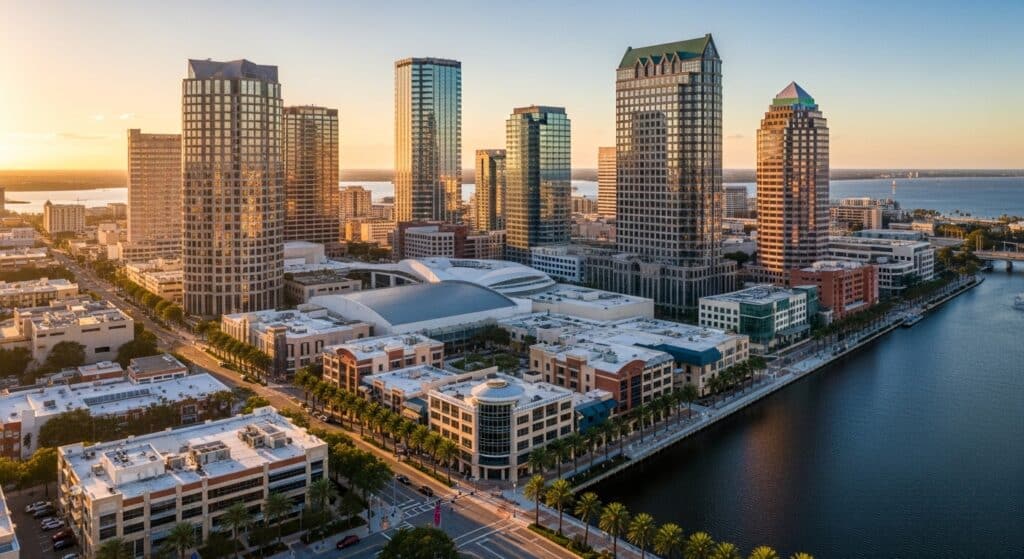
The transformation of downtown Tampa over the past decade — particularly the Water Street district — has been one of the most significant urban redevelopment stories in the Southeast. What was once a sleepy waterfront has become a walkable, mixed-use neighborhood with new office towers, hotels, residential, and retail. Pricing here is at the top of the market, but so are the long-term fundamentals.
Westshore Business District
Westshore has long been Tampa’s premier office submarket, home to corporate headquarters, financial services firms, and professional services tenants. Its proximity to the airport and major highways gives it lasting appeal. Office, hotel, and retail product in Westshore continues to trade at a premium, while value-add opportunities exist for investors willing to reposition older assets.
South Tampa and Hyde Park
South Tampa, including the Hyde Park area, is one of the most affluent residential corridors in the metro. Retail, medical office, and small mixed-use properties here benefit from high household incomes and strong consumer spending. Investors targeting necessity and lifestyle retail often find their best opportunities in this part of the city.
Brandon, Riverview, and the Eastern Suburbs
To the east of Tampa, Brandon and Riverview have experienced sustained residential growth, and commercial development has followed. Retail centers, medical office, and industrial flex space in these submarkets often offer better cap rates than core urban product, with strong demographic tailwinds supporting long-term value.
North Tampa, USF, and the Innovation Corridor
The area around the University of South Florida and the broader Tampa Innovation District has emerged as a research and life sciences hub. Medical office, lab space, and student-serving retail are particularly active here, supported by the university, major hospital systems, and growing biotech investment.
Port and Industrial Submarkets
Industrial demand clusters around Port Tampa Bay, the I-4 corridor heading toward Orlando, and submarkets along major highways. These areas continue to see institutional capital flow into both new development and stabilized acquisitions, with smaller flex product available for private investors.
Comparing Tampa to Neighboring Florida Markets
Investors often weigh Tampa against other Florida metros — Orlando, Miami, Jacksonville, and the Sarasota–Bradenton area. Tampa typically offers a balance: stronger fundamentals than smaller secondary markets, but more accessible pricing than South Florida’s most competitive corridors. For investors building a Florida portfolio, Tampa often serves as the diversification anchor between South and Central Florida holdings. If you are also weighing opportunities further east on the I-4 corridor, our 2026 playbook on commercial buildings for sale in Orlando breaks down the key differences in pricing, cap rates, and tenant demand between the two markets.
How to Buy Commercial Property for Sale Tampa: A Practical Process
Buying commercial real estate is fundamentally different from buying residential. The diligence is deeper, the financing more complex, and the consequences of mistakes more expensive. Here is a practical framework to navigate the process in Tampa.
Step 1: Define Your Investment Thesis
Before looking at a single listing, clarify what you are trying to accomplish. Are you seeking stable, long-term cash flow? Value-add upside through repositioning? A development play with a multi-year horizon? Owner-occupancy for your business with the building as a wealth-building tool? Each of these objectives points toward different asset types, locations, and deal structures. A clear thesis prevents the most common error in commercial real estate: chasing deals that look attractive in isolation but do not fit a coherent strategy.
Step 2: Assemble Your Team
Successful commercial transactions involve a team. At minimum, you will want a commercial real estate broker who specializes in your target asset class, a commercial real estate attorney familiar with Florida law, a CPA who understands the tax implications of CRE ownership, and a lender or mortgage broker who can structure appropriate financing. For larger or more complex deals, you may also need environmental consultants, structural engineers, property management partners, and 1031 exchange intermediaries. If you’re still deciding whether to engage a broker for your acquisition, our overview of what a commercial real estate broker actually does explains where their value shows up most in Florida transactions.
Step 3: Underwriting and Financial Analysis
Once a target property is identified, the real work begins. Underwriting involves analyzing historical financials, projecting future cash flows, modeling debt scenarios, and stress-testing assumptions. Key metrics include net operating income (NOI), cap rate, cash-on-cash return, debt service coverage ratio, and internal rate of return (IRR). In Tampa, special attention should be paid to rising insurance costs, property tax reassessments at acquisition, and any flood zone or wind exposure considerations that affect both insurability and long-term operating economics.
Step 4: Due Diligence
The due diligence period is your opportunity to verify everything the seller has represented and to uncover anything they have not. Key components include physical inspection, environmental Phase I (and possibly Phase II) assessments, title review, survey, zoning verification, lease audit, tenant estoppel certificates, and review of any service contracts or operating agreements. In Florida, additional considerations include flood zone determination, hurricane resilience features, and roof condition — all of which directly affect insurability. If you’re considering a triple-net asset, our breakdown of what NNN means in real estate covers exactly which expenses transfer to the tenant and which still land on the owner — a distinction that meaningfully changes your underwriting.
For more on the technical side of property evaluation, the U.S. Small Business Administration’s commercial real estate resources offer helpful general guidance, particularly for owner-occupants exploring SBA-backed financing.
Step 5: Financing the Acquisition
Commercial financing options range from traditional bank loans and credit unions to life insurance company debt, CMBS, agency debt for multifamily, SBA loans for owner-occupants, and private credit for transitional assets. Each has different terms, leverage, and prepayment characteristics. In a normalized rate environment, structuring your debt thoughtfully can have an outsized impact on your equity returns — sometimes improving them by double-digit percentages compared to suboptimal financing choices.
Step 6: Closing and Transition
Closing a commercial transaction involves coordination across attorneys, lenders, title companies, escrow agents, and sometimes the existing property manager. Once closed, the transition period — typically the first 30 to 90 days of ownership — is critical. This is when you implement your business plan, communicate with tenants, address deferred maintenance, and set the operational tone for your hold period.
Common Pitfalls to Avoid When Evaluating Commercial Property for Sale Tampa Listings
Even experienced investors make mistakes. Some of the most common in the Tampa market include underestimating insurance and property tax increases, overpaying for value-add upside that depends on aggressive rent growth assumptions, ignoring submarket-specific supply pipelines, and failing to account for hurricane preparation and resilience costs. A disciplined process and an experienced team are the best protection against these errors.
For additional perspective on local economic and demographic data that can inform your underwriting, the Tampa Bay Economic Development Council publishes regularly updated information on industries, workforce, and major employer activity in the region.
Final Thoughts: Making the Most of the Tampa Opportunity
The Tampa commercial real estate market in 2026 offers a rare combination of strong fundamentals, diverse asset opportunities, and a more rational pricing environment than the market has seen in several years. For investors who do their homework, build the right team, and approach each acquisition with discipline, the opportunities are substantial — across retail, office, industrial, multifamily, land, and specialty assets.
What separates successful CRE investors from frustrated ones is rarely access to deals. It is the quality of their analysis, the depth of their relationships, and the patience to wait for the right opportunity rather than forcing the wrong one. Tampa rewards that approach.
If you are exploring commercial property for sale in Tampa and want to discuss your investment goals, evaluate specific opportunities, or simply get a clearer read on where the market is heading, we would love to hear from you. Get in touch with our team for a no-pressure conversation about how to position your capital in one of the country’s most exciting CRE markets — and let’s build a strategy that fits your goals, your timeline, and your risk profile.